


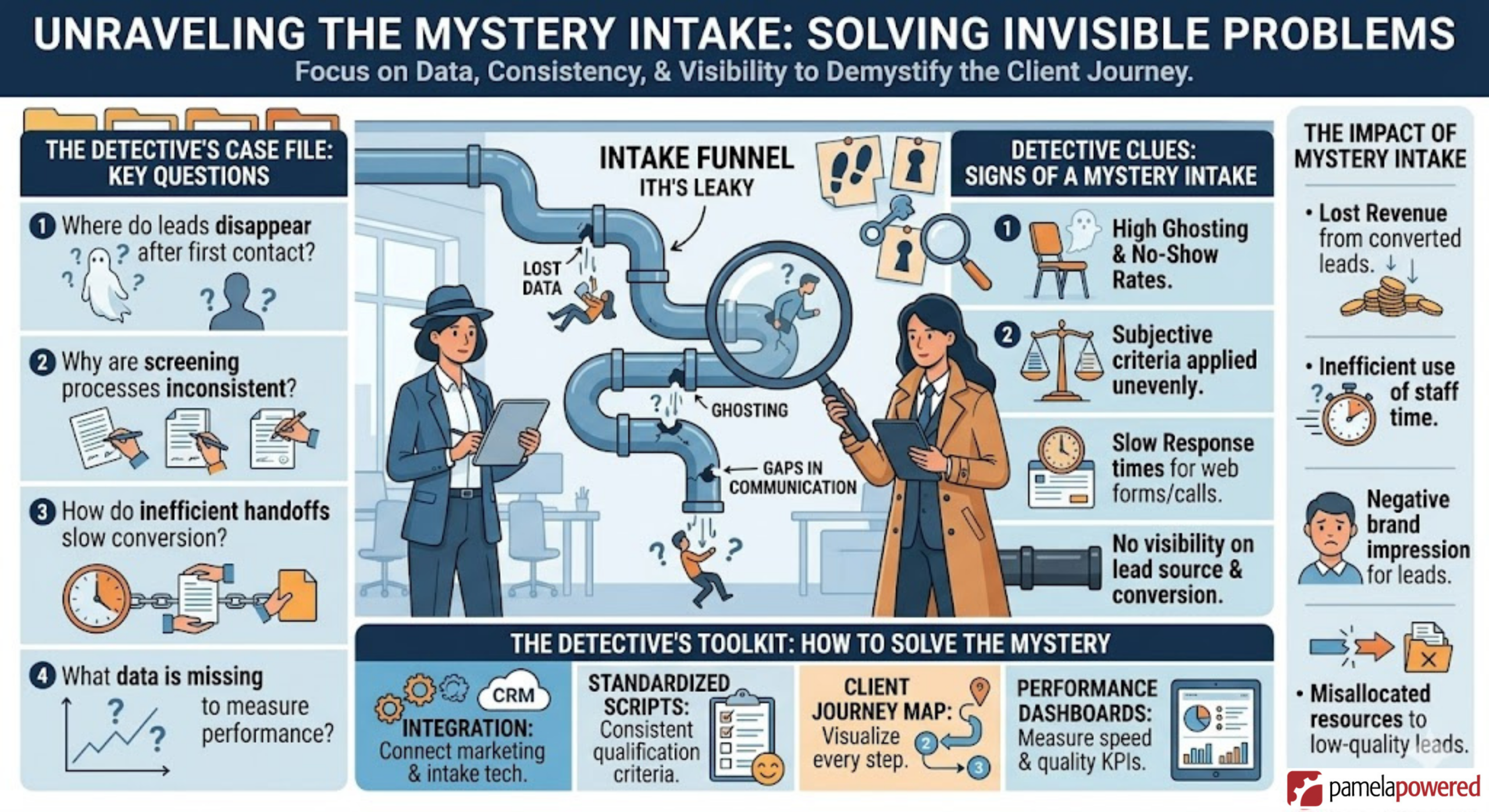
I ‘ve always been drawn to a good mystery, especially the British murder mysteries I binge on streaming, where the answers were right there all along if anyone had bothered to look closely. That’s intake.
I love the variety of professional services marketing. In 30+ years from KPMG and PwC to boutique B2C law firms, I’ve never gotten bored with the strategy, the campaigns, the data, the creative problem-solving. But at the core of everything I do is a passion for making meaningful connections. Between firms and the clients who need them. Between lawyers who can help each other. Between marketing effort and measurable results.
Intake is where all of those connections either happen or fall apart. And that’s why I can’t leave it alone.
I was hooked from my first intake project as head of marketing and business development at a top PI boutique firm. The firm had a stellar reputation and an amazing referral network. When the phone rang, it was almost always someone who’d been sent by a trusted source, warm leads who already trusted the firm before they walked in the door. A sophisticated intake system wasn’t necessary because the relationships did the heavy lifting. Sure, they lost files to competitors, but it didn’t seem to be a big issue.
Then the firm decided to invest heavily in PPC.
Suddenly, the phone was ringing more, but the callers were different. They were shopping. They were comparing firms. They didn’t arrive pre-sold by a referring lawyer. They clicked on an ad. And the intake process that worked perfectly well for referrals couldn’t handle cold leads.
What I discovered was that there was no single point of failure. The increased call volume from PPC was overwhelming the receptionist. Intake sheets were handwritten, inconsistent, and incomplete. The handoff to the lawyers varied by who took the intake, and follow-up was sporadic. There were multiple contributing factors, and the only way to find them was to go through the process one by one, from first ring to signed retainer, and see where the leaks were hiding. The oversight was costing the firm lost revenue on top of the PPC investment and missed opportunities. And from where I sat, I had no way to track whether my campaigns were actually working. My reports to the partners were best guesses at best.
That realization is what got me hooked. And I’ve been solving intake mysteries for other firms ever since.
The Scene of the Crime
Here’s how it usually starts. A firm is spending real money on marketing. The website looks good. The campaigns are running. The phone is ringing. But revenue isn’t where it should be. The partners blame marketing. Marketing blames the leads. Nobody’s looking at what happens in between.
That’s the crime scene. Leads are disappearing, and nobody’s investigating.
When you start digging, it gets interesting fast. Why are 40% of calls going to voicemail? Why does one lawyer convert consultations at twice the rate of another? Why did the firm spend $15,000 on a family law campaign that generated eighty leads and three clients? The answers are never where people think they are.
Following the Clues
What I love about intake is that the clues are everywhere. You just have to know where to look and be willing to follow them wherever they lead.
The data tells you one story. Call volume is up. Web forms are coming in. The numbers look healthy on the surface. Then you talk to the intake team and hear a different story. Half of those calls are in the wrong practice area. The web forms don’t include enough information to follow up. The after-hours calls never get returned.
Then you talk to the lawyers and hear a third story. They think intake is fine. They’re busy. They’re taking consultations. They don’t understand why marketing keeps asking about conversion rates when they’re already working nights and weekends.
Three versions of reality. None of them is complete. All of them are partially true. That’s the mystery, and solving it requires you to hold all three perspectives at once and find where the real oversight is hiding.
And there’s often a fourth clue nobody thinks to look for: what’s happening to the leads the firm can’t take? Every declined call, wrong practice area, too small, outside the jurisdiction, is a connection that isn’t being made. Is anyone referring those callers to a trusted lawyer? Is anyone tracking whether those referral relationships are being nurtured? In most firms, the answer is no. Those leads vanish, and with them, the relationships that could have been sending business back your way.
Every Firm Is a Different Case
This is the part that keeps me coming back. No two firms have the same intake mystery.
At one firm, the problem is speed. Leads are good, but callbacks take two days and by then the prospect has hired someone else. At another, the problem is screening. Intake is booking consultations with everyone who calls, burning lawyer time on cases the firm would never take. At another, the conversion rate from consultation to signed client is inexplicably low, and nobody has asked why until you start sitting in on meetings and realize the lawyer is quoting fees that don’t match what the website promises.
Same five stages of intake. Completely different breakdowns. Completely different solutions. You can’t copy and paste someone else’s answer because the mystery is always specific to the firm, its people, its practice areas, and its clients.
The Human Element
Intake isn’t just a process problem. It’s a people problem. And that’s what makes it endlessly interesting.
The person answering the phone is talking to someone on one of the worst days of their life. They’ve been in a car accident. They’re going through a divorce. They’ve been fired. They’re scared, confused, and overwhelmed, and they’re calling a stranger for help.
How that call is handled is a human interaction first and a business process second. The empathy of the intake person, the tone of their voice, the questions they ask, whether they make the caller feel heard or processed. All of that happens before any technology, any CRM, any data point comes into play.
This is where meaningful connections aren’t just a marketing concept. They’re the moment a frightened person decides whether to trust your firm. And it applies equally to the callers you can’t help. The person you refer with care and empathy to another lawyer remembers how your firm treated them. That’s your brand, working even when the case isn’t yours.
As a marketer, you can build the most sophisticated intake funnel in the world. But if the human at the first point of contact doesn’t make that caller feel like they’ve reached someone who cares, none of it matters. That tension between system and human is what makes intake so rich to work on.
The Satisfaction of the Solve
Every good mystery has a resolution. In intake, the resolution is measurable.
And here’s what surprises most firms: the fixes don’t have to be expensive. My years at KPMG taught me to be cost-conscious in every solution, and that discipline has carried over to every intake project since. You don’t need a six-figure CRM to stop the bleeding. Start documenting the process so everyone can see it, then build on it. Set up a simple Google Sheets spreadsheet to track lead source, response time, and outcome, then expand it as you learn what matters. Write intake scripts so screening is consistent. Develop procedures for handoffs, follow-up, and declined leads. Train your staff on all of it. Each step costs almost nothing and reveals more about your intake process than most firms have ever known.
Start with what you have. Find the oversight. Fix what you can. The expensive technology can come later, once you know exactly what you need it to do.
You mapped the process. You found the oversight. You fixed the handoff, or retrained the team, or built the follow-up sequence, or aligned the messaging between website and intake. And now you can see the numbers move. Conversion goes up. Cost per client goes down. Leads that used to vanish are turning into consultations. Consultations are turning into signed retainers. Declined leads are turning into referral relationships that send business back.
The solution is never one thing. It’s a series of small fixes throughout the process, each making a meaningful difference when they work together.
That direct line between investigation and result is rare in marketing. So much of what we do is indirect. Brand building, awareness, and content that may or may not drive action months from now. Intake gives you an immediate, concrete feedback loop. You changed something. The numbers moved. The firm made more money. The connections got stronger.
For someone who loves solving problems, that’s addictive.
Why More B2C Legal Marketers Should Get Hooked
I think most B2C legal marketers would find intake just as fascinating if they spent real time inside it. The problem is that most of us have been told, explicitly or implicitly, that it’s not our department. So we stay on our side of the line, optimizing campaigns and reporting on leads, never seeing what happens after the handoff. If that sounds familiar, I wrote about practical ways to change that.
If any of this series has resonated with you, I’d encourage you to cross that line. Ask to listen to calls. Look at the data. Map the process. Start asking the questions nobody has been asking. Pay attention to the leads that leave as much as the ones that convert.
You might just find you can’t stop pulling at the thread either. Because at its heart, intake is about making meaningful connections. Between your firm and the people who need it, between the leads you can’t take and the lawyers who can help, and between the marketing dollars you spend and the results they actually produce.
This is part of my series on marketing and intake for B2C law firms. If you missed the earlier posts, start with why B2C legal marketers can’t afford to ignore intake, then how to get a seat at the intake table, and what your intake technology should actually do.
Tired of the mystery? If your intake process has more questions than answers, an outside assessment can cut through the noise. I help B2C law firms map what’s actually happening from first contact to a signed retainer, identify leaks, and fix them. See how the Intake Advisory engagement works.