


 If you’re a legal marketer at a plaintiff or B2C law firm, you’ve had this conversation: leadership looks at the marketing spend, looks at the caseload, and asks why the numbers don’t match. The implication is clear. Marketing isn’t working.
If you’re the managing partner asking that question, I have news: you’re probably looking in the wrong place.
I’ve spent 25 years in professional services marketing, and the last several working specifically with consumer-facing and plaintiff law firms on intake optimization and referral network development. The pattern I see is remarkably consistent. Firms pour money into lead generation, and the leads come in. Then they lose cases in the gap between the first call and the signed retainer. Marketing gets blamed. The intake team gets blamed. But when you actually map the process, the real story is usually more complicated and more fixable than anyone expected.
I recently joined a panel on intake operations for the Legal Marketing Association’s B2C SIG (Special Interest Group), a dedicated group for Plaintiff marketers within LMA, which I founded in 2018. The conversation reinforced what I see every day in my consulting work: most firms don’t have a marketing problem. They have a handoff problem.
Map the Process Before You Fix It
The first thing I do with any firm is map the intake workflow: visually, end-to-end, from the moment a potential client makes contact to the moment they either sign a retainer or fall out of the pipeline. Every step, every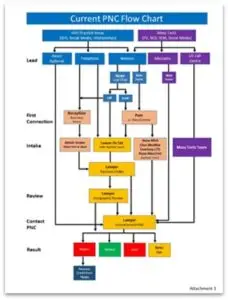 handoff, every decision point.
What I consistently find is that the blame falls on the wrong person. The assumption is usually that the intake team isn’t answering the phone fast enough, and sometimes that’s true. But more often, the real leaks are further downstream. The time it takes for a lawyer to follow up after the intake team qualifies a lead. The number of steps between the initial call and the consultation. The handoffs between intake staff, paralegals, and lawyers, where a file sits in someone’s queue for a day or two while the potential client calls another firm.
If you’re the marketer, this is your most powerful move: present the intake workflow to leadership as a visual map. Not a spreadsheet, not a verbal explanation at a meeting, but an actual diagram showing each stage with the time elapsed at every handoff. When management can see where the bottlenecks are, the conversation shifts from “marketing isn’t delivering” to “we have a process problem.” And critically, they can see that the intake team they’ve been blaming may actually be doing their job fine. The breakdown is happening when the file moves to the lawyers.
If you’re the managing partner or practice group leader, this matters because it’s your revenue walking out the door. Lawyers don’t typically think intake is their problem until the data shows that a 48-hour callback window is why qualified leads are signing with the firm down the street. Adding timing to each handoff stage takes the argument out of the realm of opinion and puts it squarely into evidence. Data doesn’t lie, and lawyers respect evidence.
For the marketer, this is also how you protect your own position. If you’re not tracking intake data alongside your marketing metrics, you’re leaving yourself exposed when performance review time comes around. The leads you generated that died in intake are invisible unless you make them visible.
Every Declined Case Is a Relationship Waiting to Happen
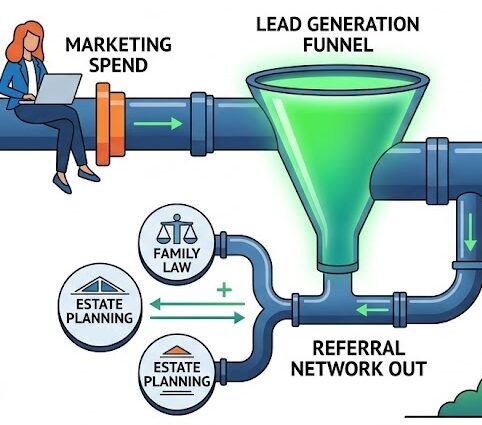 The second major opportunity most firms miss is what happens to the cases they don’t take. At a typical plaintiff firm, a significant percentage of inquiries don’t fit the firm’s practice areas or don’t meet the threshold for the firm to take on. At most firms, those callers get a polite “sorry, we can’t help you,” and that’s the end of it.
That’s a waste, not just for the caller, but for the firm.
When a firm already has relationships with lawyers in other practice areas, incorporating a referral process into intake is relatively straightforward. You maintain a list of trusted lawyers in complementary areas: family law, immigration, criminal defence, estate work, whatever falls outside your firm’s focus, and when a case doesn’t fit, you don’t just decline it. You refer to it.
When a firm doesn’t have those relationships yet, the process starts with identifying target lawyers: former law school classmates, lawyers with strong reputations whom your lawyers would like to build a relationship with, practitioners in areas that complement your firm’s work. Having a warm referral in hand is one of the best ways to start a professional relationship. It’s hard to ignore a call from someone who says, “I have a client who needs your help.”
The referral itself is the relationship builder. And when that relationship matures, referrals start to flow back. This is why I tell firms that intake optimization and referral network development aren’t two separate initiatives: they’re the same system. Your intake process is the engine that feeds your referral network, and your referral network is what turns declined cases into future business.
For marketers, this is a program you can own. Building the referral list, creating the tracking system, reporting on referral volume and reciprocity; this is strategic marketing work that directly ties to revenue. It’s also the kind of initiative that elevates your role from “the person who runs the ads” to a business development partner.
The key is tracking. Every referral out needs to be logged: who you sent it to, which practice area, and whether you ever heard back. Without that data, you have no way to evaluate which relationships are reciprocal and which are one-directional. And without accountability, the whole system dies quietly.
Start With What You Can Control
Whether you’re the marketer building the case or the managing partner ready to act, the starting point is the same. You don’t need a six-figure CRM implementation or an AI-powered intake platform. You need three things:
A visual map of your current intake process, with honest time estimates at each handoff. A tracking mechanism for declined cases and outbound referrals, even a spreadsheet, works. And a conversation where marketing and firm leadership sit down to review both, identifying where leads are leaking and where potential referral revenue is being left on the table.
The firms that get this right don’t just close more cases. They build reputations as firms that take care of people even when they can’t take the case. That’s a brand differentiator you can’t buy with ad spend. And for the marketer who builds the system that makes it happen, it’s a career differentiator too.
Pamela Foster is the principal of Pamela Powered, a legal marketing consultancy specializing in intake optimization, referral network development, and fractional CMO services for plaintiff and B2C law firms across North America. She is the founding chair of the Legal Marketing Association’s B2C/Plaintiff Special Interest Group.
Book a consultation: calendly.com/pampower