


 Legal technology vendors will happily sell you the future of intake. Slick dashboards, AI-powered everything, integrations with tools you’ve never heard of. But before you evaluate a single product, you need to know which questions your technology should answer at every stage of the intake process.
This isn’t a product review. Products change. Your needs don’t. Whether your firm is running intake on sticky notes or a six-figure CRM, these are the capabilities that matter — and the red flags that tell you something isn’t working.
Stage 1: First Contact
This is the moment a potential client reaches out — by phone, web form, chat, email, or social media. It’s also the moment most firms start losing leads without knowing it.
Your technology at this stage should answer three questions. How fast are we responding? Where did this lead come from? Did we capture enough information to follow up?
Potential clients are reaching out across more channels than ever. Phone, email, web forms, chat — and according to Scorpion, 51% of legal consumers won’t even hire a firm that lacks online chat. Your intake system needs to capture and track leads across all of these channels, not just the ones your firm prefers.
For phone calls, speed starts with answering the phone. Not returning the call. Answering it. A potential client in crisis — facing a divorce, injured in an accident, dealing with a wrongful termination — is not leaving a voicemail and waiting patiently. They’re calling the next firm on the list. And the data backs this up: Clio’s 2024 mystery shopper study found that 48% of law firms were essentially unreachable by phone.
Count to thirty. That’s how long a caller in crisis will wait before dialing the next firm on the list.
Your system should tell you how many calls are answered, how many are missed, and how quickly they’re picked up. If you don’t know your answer rate, I promise it’s worse than you think.
For web forms and chat, the same urgency applies. The same Clio study found that 42% of firms that received a voicemail or web form submission failed to respond for at least 3 days. Three days. In B2C law, the caller has already hired someone else. Whatever system you use, it should timestamp every inbound contact and alert someone immediately. If a web form submission sits in an inbox for hours before anyone sees it, your technology has failed before intake even starts.
Source tracking matters just as much. If you can’t tie every call, form, and chat to the marketing channel that generated it, you’re spending blind. This is where marketing and intake technology must talk to each other. Call tracking numbers, UTM parameters, and form source fields aren’t optional — they’re the basic wiring that connects your marketing spend to actual results.
Stage 2: Screening and Qualification
Not every call is a case. Intake needs to determine quickly whether the caller has a matter the firm handles, whether it falls within the firm’s criteria, and whether there are any conflicts or jurisdictional issues.
Your technology should answer the question: Are we qualifying consistently? Are we capturing the reason we decline cases? How long does screening take?
Consistency is the keyword. If three different intake staff ask different questions in different orders and record information in different places, you don’t have a process — you have three processes. Your system should provide a structured intake script or questionnaire to ensure every caller has the same experience and every lead is evaluated against the same criteria.
But consistency isn’t just about efficiency — it’s about your brand. Every call is a brand experience, including the ones you can’t take. The person calling about a matter outside your practice areas still walked away with an impression of your firm. Did someone listen to them? Did someone try to help — even if that meant referring them to another lawyer or directing them to the Law Society? A caller you treat well when you can’t help them is more likely to recommend your firm to a friend who needs exactly what you do. Your intake process should reflect your firm’s values on every call, not just the ones that convert.
Equally important is tracking what you decline and why. This is data most firms throw away, and as I discussed in my previous article on getting a seat at the intake table, those declined leads are referral opportunities walking out the door. If your system doesn’t capture the practice area, the reason for decline, and whether a referral was made, you’re losing intelligence and relationships with every call you can’t take.
Stage 3: Consultation Scheduling
The caller qualifies. Now what? In too many firms, this is where momentum dies. The handoff from intake to consultation is clunky, slow, or dependent on someone checking a lawyer’s calendar and calling back.
Your technology should answer the question: How quickly are we moving qualified leads to the next step? How many drop off before they get there? Are we sending confirmations and reminders?
In many B2C firms, the next step isn’t an in-person consultation — it’s a callback from a lawyer to gather more details, assess the case further, and determine if an in-person meeting makes sense. Your system needs to manage this handoff seamlessly. How quickly is that callback happening? Is the lawyer getting the information intake already collected, or is the caller repeating everything from scratch? If intake is doing its job well and the technology supports it, the lawyer picks up the file already knowing who they’re calling and why.
Some B2C firms charge a consultation fee, which adds another friction point. If there’s a cost involved, the caller needs to know that before they book — not when they show up. If your website says “free consultation” but the intake team is quoting a fee, or vice versa, you’ve created a disconnect that kills trust at the worst possible moment. Your technology and your messaging need to be aligned on this.
Automated confirmations and reminders reduce no-shows, which are a silent killer of intake efficiency. A lead who doesn’t show for their consultation costs you the marketing dollars to generate them, the intake time to qualify them, and the consultation slot that could have gone to someone else.
Stage 4: Consultation and Conversion
The potential client meets with the lawyer. This is where the case is either signed or lost — and it’s the stage where most firms have the least data.
Your technology should answer the question: What percentage of consultations convert to signed clients? How long does it take from consultation to a signed retainer? What are the reasons people don’t retain?
If your system tracks everything up to the consultation but goes dark after that, you’ve built half a funnel. Marketing needs to know what happens in this room — not the details of the legal conversation, but the outcome. Did they sign? If not, why? Was it price, timing, fit, or something else?
One of the most valuable things I’ve done as an in-house marketer is sit in on consultations — with the prospect’s permission. You learn things that data can’t tell you. What questions do prospects ask? What concerns come up repeatedly? What information are they missing? That firsthand insight directly shaped the “Welcome Kit” take-away materials we provided — FAQ sheets, process overviews, next-step guides — all tailored to the real questions real prospects were asking. If you can’t sit in the room, the data from your system is the next best thing.
This data closes the loop. It tells marketing which channels produce leads that actually convert to revenue, not just leads that book consultations. There’s an enormous difference between a campaign that generates 50 consultations and one that generates 20 consultations, with 60% signing.
Stage 5: Follow-Up and Nurturing
Not everyone signs on the spot. Not everyone who calls is ready to hire a lawyer today. This stage is where most B2C firms have no system at all — and it’s where some of the easiest revenue is hiding.
Your technology should answer the question: Are we following up with unconverted leads? How many times, over what timeframe, and through what channels? Are we tracking who comes back?
A person who calls about a divorce but isn’t ready to file today might be ready in three months. If no one follows up, they’ll call another firm when they’re ready. A simple automated nurture sequence — a few emails over a few weeks — keeps your firm in their mind without requiring anyone’s time.
The same applies to leads that fell off at any earlier stage. The person who didn’t show for their consultation. The caller who qualified but never scheduled. These aren’t dead leads — they’re dormant ones, and a system that tracks and re-engages them recovers revenue you’ve already paid to generate.
And when a prospect is ready to move forward, don’t let the paperwork slow things down. E-signature technology lets a client sign a retainer agreement from their phone minutes after a consultation — while the conversation is still fresh and their motivation is high. Every day between “yes, I want to hire you,” and a signed retainer is a day they might change their mind, get cold feet, or take a call from another firm. That said, e-sign isn’t universally accepted in every jurisdiction or for every document type, so firms need to confirm what’s permissible in their practice area and location. But where it’s allowed, removing the friction between decision and signature is one of the simplest conversion wins available.
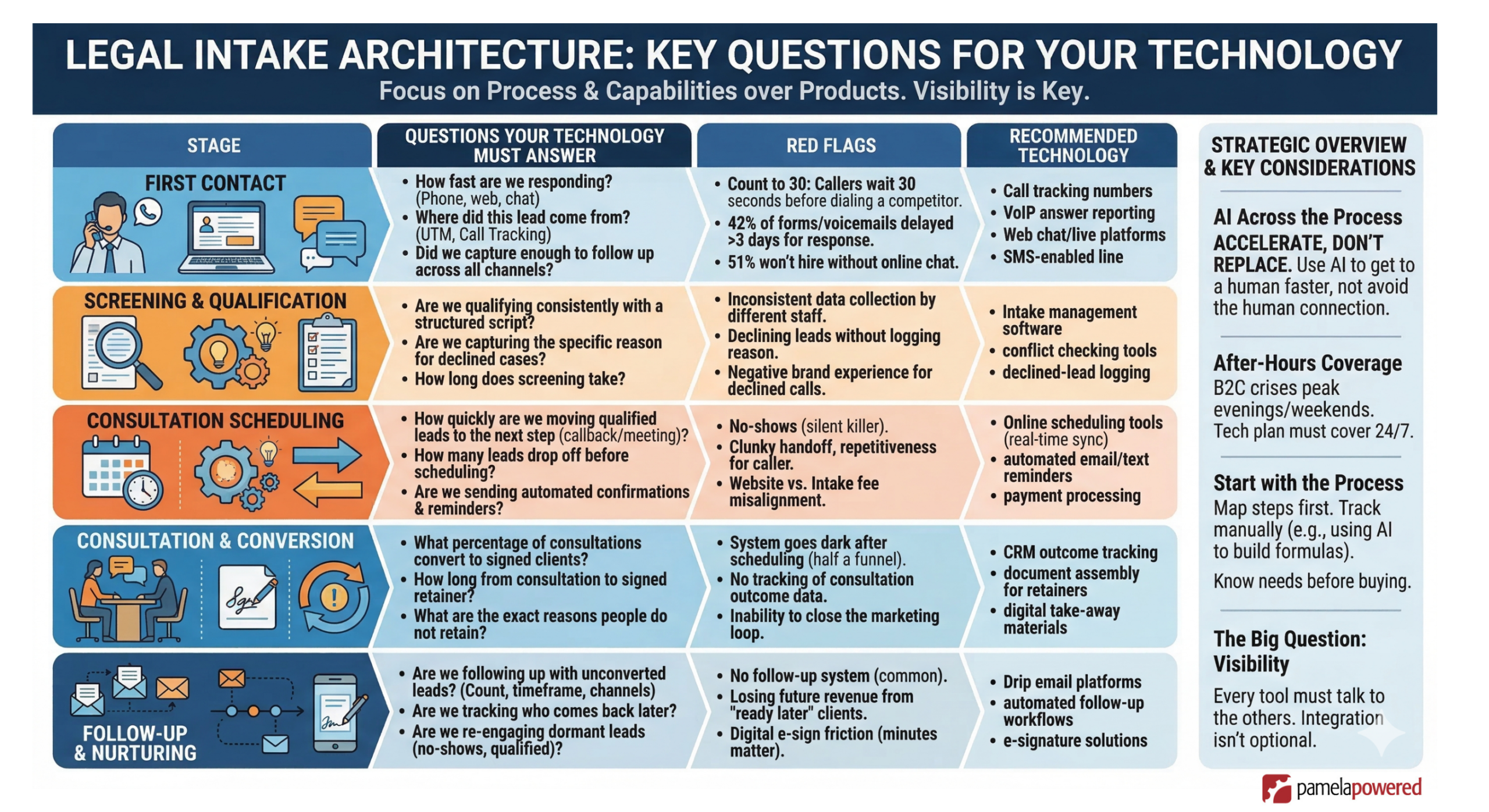
Technology to Consider at Each Stage
This isn’t a product recommendation list — tools change, merge, and get acquired. But these are the technology categories to evaluate at each stage of your intake process.
First Contact: Call tracking software, VoIP phone systems with answer-rate reporting, web chat and live chat platforms, multi-channel CRM with lead capture, auto-responders for web form and email submissions, SMS/text-enabled business lines.
Screening and Qualification: Intake management software with structured questionnaires and scripts, conflict checking tools, practice-area routing rules, referral tracking and declined-lead logging within your CRM.
Consultation Scheduling: Online scheduling tools with real-time calendar integration, automated confirmation and reminder sequences via email and text, payment processing for firms that charge consultation fees.
Consultation and Conversion: CRM with outcome tracking (signed, not retained, reason codes), document assembly for retainer agreements, digital take-away materials triggered by practice area or case type.
Follow-Up and Nurturing: Email marketing and drip-campaign platforms, automated follow-up sequences within your CRM, e-signature solutions for retainer agreements, and lead re-engagement workflows for dormant contacts.
AI Across the Process: AI is showing up at every stage of intake — chatbots handling after-hours initial contact, natural language processing to route leads by practice area, predictive scoring to prioritize high-value leads, automated call transcription and sentiment analysis, and AI-assisted follow-up sequencing. The technology is evolving fast, and the capabilities are real. But a word of caution: most legal consumers still want to talk to a human when it matters. Scorpion’s research found that while consumers welcome AI for administrative tasks like scheduling and gathering basic information, they expect human interaction for anything that feels like legal guidance. AI should accelerate your intake process, not replace the human connection that makes a caller trust your firm. Use it to get to the human faster, not to avoid the human altogether.
After-Hours Coverage: B2C legal problems don’t happen during business hours. Car accidents, arrests, domestic crises — these peak evenings and weekends. If your intake technology only covers 9–5, you’re missing the calls with the most urgency and the highest intent. Whether it’s a virtual receptionist service, an AI chat that captures details for morning follow-up, or a rotating on-call system, your technology plan needs to account for incoming calls when nobody’s at the desk.
There’s more to consider — how you build reporting dashboards that give marketing real-time visibility, how to prioritize technology investments when you can’t do everything at once, and how to handle the data privacy implications of collecting sensitive personal information during intake. Each of these deserves its own conversation, and I’ll be exploring them in upcoming posts.
The common thread across all five stages is that your tools need to talk to each other. The best call tracking software in the world is useless if it doesn’t feed data into your CRM. A brilliant scheduling tool is useless if no one knows which marketing channel generated the appointment. Integration isn’t a nice-to-have — it’s the whole point.
Don’t Let the Technology List Overwhelm You
If you’ve read through five stages of intake technology and feel like you need a six-figure budget to get started, take a breath. You don’t.
Start with the process. Map every step from first contact to signed retainer — on a whiteboard, in a document, wherever works. You can’t fix what you haven’t defined.
Then start tracking with what you have. A well-built spreadsheet can capture lead source, contact method, response time, screening outcome, consultation status, and conversion result. It’s not glamorous, but it gives you data you didn’t have yesterday. And tools like Claude and other AI assistants can help you build those tracking spreadsheets in minutes — structured, formula-ready, and tailored to your firm’s specific intake stages.
Here’s the real payoff: once you’ve been tracking manually for a few months, you’ll know exactly what data points matter to your firm. You’ll understand your own process deeply enough to ask the right questions when you start evaluating CRMs. Instead of buying technology and hoping it fits, you’ll be shopping with a clear picture of what you need it to do. That’s the difference between an educated buyer and an overwhelmed one.
The Question Behind All the Questions
Every capability I’ve described comes down to one thing: visibility. Can you see what’s happening at each stage? Can you measure it? Can you act on it?
There are excellent tools in every category — from full-suite legal CRMs to standalone scheduling and call tracking solutions. The right one depends on your firm’s size, practice areas, budget, and how much of this process you handle in-house versus outsourcing. What matters more than the specific product is whether your technology gives you an unbroken line of sight from first contact to signed client.
If it doesn’t, you’re not making decisions. You’re making assumptions.
This article is part of my series on marketing and intake for B2C law firms. If you missed the earlier posts, start with why B2C legal marketers can’t afford to ignore intake and how to get a seat at the intake table.
Know what your technology should do, but not sure where to start? The technology only works if the underlying process is right. I help B2C law firms assess their current intake workflow, select the right tools for their budget, and implement a system their team will actually use — starting with a structured assessment before anyone shops for software. Learn about the Intake Advisory engagement.