

 Most B2C law firms invest in intake technology expecting it to solve their conversion problems. But the firms that actually improve their intake results start with process, people, and an experienced advisor before they ever shop for software.
I’ve seen this movie before.
Early in my career, I spent years as global head of marketing for PwC’s Oracle Consulting practice. My job was helping companies understand why they needed expert advisors to assess, plan, and manage the integration of Oracle ERP systems. What I learned watching that process play out across dozens of organizations has stayed with me ever since.
The companies that succeeded didn’t just buy Oracle. They invested in understanding their current processes before the software arrived. They mapped workflows. They identified gaps. They planned for change management. They brought in advisors who could see what the internal team couldn’t, because they’d done it before and knew where the landmines were.
The companies that failed? They bought the technology and expected it to fix everything. Six months later they had an expensive system nobody used properly, processes that hadn’t actually changed, and teams that had quietly reverted to their old ways of doing things. The software wasn’t the problem. The sequence was.
I see the exact same pattern playing out in B2C law firm intake.
Why Technology Alone Won’t Fix Your Intake Process
In my previous article, I walked through the technology your intake process should have at every stage. The categories are real, and the capabilities matter. But here’s what I’ve seen happen too many times: a firm reads a list like that, gets excited, starts shopping for tools, and skips everything that needs to happen first.
The technology isn’t the problem. The sequence is.
A firm invests in new intake tools, expecting the problems to go away. But calls still go unanswered because nobody redesigned the call flow. Intake forms are now digital but still inconsistent because nobody standardized the questions. The handoff to lawyers is faster but still disorganized because nobody has defined the process. Follow-up is automated but irrelevant because nobody mapped the client journey.
The firm didn’t fix intake. They digitized a broken process.
This is exactly what I watched happen with ERP implementations at PwC. The technology was powerful. The technology was capable. But without someone assessing the current state, defining the desired future state, and managing the human transition between the two, the technology just made the mess run faster.
What Actually Improves Law Firm Intake Conversion
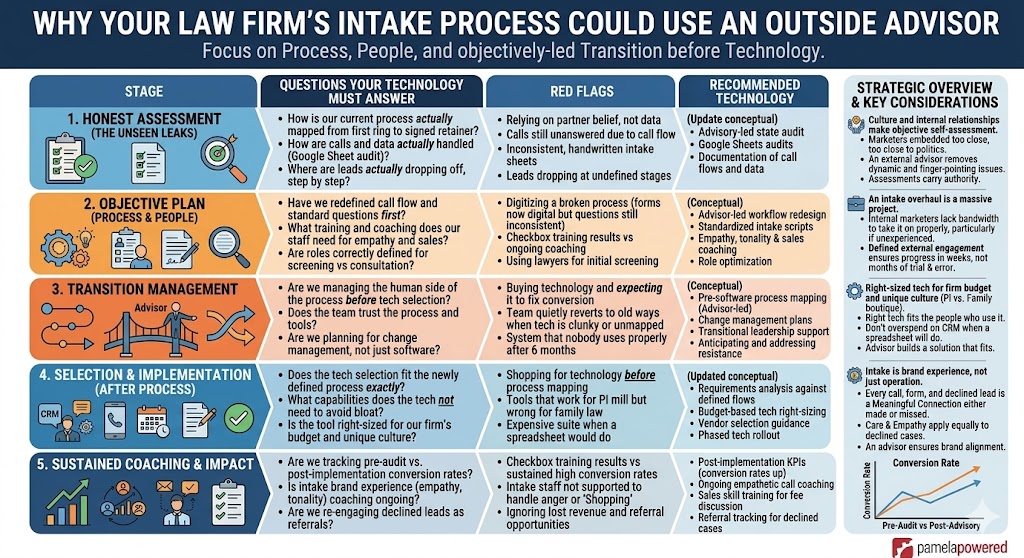
Fixing a law firm’s intake process requires three things, and only one of them is technology.
First, you need an honest assessment of what’s happening now. Not what people think is happening. Not what the partners believe is happening. What is actually happening, step by step, from first ring to signed retainer. This means documenting the process, listening to calls, reviewing intake sheets, tracking response times, and following leads through every stage to see where they drop off and why. As I wrote in my technology article, this can start with something as simple as a Google Sheets spreadsheet. You don’t need fancy tools to see the truth.
Second, you need a plan that addresses process, your culture and technology together. Which steps need to change? Which roles need to be redefined? What training does the team need? What does the technology need to do, and just as importantly, what does it not need to do? The plan has to account for the human side, because the best tools in the world are useless if the receptionist doesn’t trust them, the intake coordinator doesn’t use them consistently, or the lawyers ignore them entirely.
Third, you need someone to manage the transition. Not just the software installation. The actual change. Someone who has seen this before, who knows which problems are universal and which are specific to your firm, who can anticipate resistance and address it before it derails the project. Someone who can translate between the technology vendor’s promises and the firm’s operational reality.
Why Intake Training and Coaching Matter More Than Software
You can document the process, write the scripts, and install the technology. But if you don’t have the right people doing intake and don’t train and coach them, nothing changes.
Who handles intake matters more than most firms realize. In smaller firms, the instinct is often to have a lawyer take the initial call. But a well-trained paralegal is often more valuable in this role. They can follow a structured screening process consistently, they’re not billing at lawyer rates, and they can spend the time needed to make the caller feel heard without the pressure of a billable clock running. The lawyer’s time is better spent on the consultation once the lead has been qualified, not on the initial screening call.
For firms that charge a consultation fee, the calculus shifts again. When you’re asking a potential client to pay before they’ve even met a lawyer, the intake person needs more than empathy and process skills. They need sales skills. They need to communicate value, handle objections, and give the caller enough confidence in the firm to pull out their credit card. That’s a specific skill set, and not everyone on your team has it. Identifying who does, and putting them in that role, can dramatically change your consultation booking rate.
Intake staff are the front line of your firm’s brand. They’re the first voice a potential client hears. They need to understand not just what to ask, but why they’re asking it. They need to know what a good call sounds like and what a bad one sounds like. They need coaching on empathy, tone, and how to handle a caller who is angry, scared, or shopping three firms at once.
This isn’t a one-time training session. It’s ongoing coaching. Listening to calls together. Reviewing outcomes. Identifying patterns. Celebrating what’s working and correcting what isn’t. The firms that treat intake training as a checkbox get checkbox results. The firms that invest in regular coaching build intake teams that convert at consistently higher rates because the staff understand the process, believe in it, and feel supported.
A good intake advisor helps determine who on your team is best suited for the intake role, builds training and coaching into the engagement from the start, and equips the firm’s internal leadership to continue that coaching after the engagement ends.
Why B2C Law Firms Struggle to Fix Intake Internally
Most B2C law firms have smart, capable marketing people. So why can’t they fix the intake process themselves?
Because they’re inside it. Culture is at the root of every law firm, and culture is the hardest thing to see clearly when you’re living in it every day. Just as a company implementing Oracle can’t objectively assess its own processes while running them, a legal marketer embedded in a firm’s daily operations often can’t see the full picture. They’re too close. They have relationships to protect. They have assumptions they don’t know they’re making. They may lack the authority to push back on a partner who insists intake is fine.
And then there’s the politics. When an internal marketer starts mapping the intake process and identifying leaks, it can feel like finger-pointing. The receptionist feels criticized. The intake coordinator gets defensive. The lawyers push back. An outside intake advisor removes that dynamic entirely. They’re not blaming anyone. They’re assessing a process. The findings carry a different weight when they come from someone who doesn’t have a stake in the firm’s internal relationships.
There’s also the practical reality of time and experience. An intake overhaul is a significant project. Documenting the process, writing scripts, listening to calls, analyzing data, evaluating technology, and training staff. An in-house marketer who is already managing campaigns, the website, social media, and reporting doesn’t have the bandwidth to take this on properly, particularly if they haven’t done it before. What might take an internal team months of trial and error, an experienced advisor can assess and plan in weeks because they’ve seen the patterns before.
An experienced advisor builds a solution that fits the firm’s budget, not a wish list. They know when a spreadsheet will do the job and when a CRM is worth the investment. They’ve worked with firms at every budget level and can right-size the solution so the firm gets maximum impact from what it can actually afford.
How to Choose the Right Intake Advisor for Your Law Firm
If you’re a legal marketer evaluating whether to bring in outside help with your firm’s intake process, here’s what matters.
The best approach is to engage an advisor at the beginning, before any technology is purchased. Let them help you identify the leaks first, then guide technology selection based on what your firm actually needs and what fits the firm’s culture. A tool that works brilliantly at a high-volume PI mill may be completely wrong for a boutique family law practice. The technology has to fit the people who will use it every day, or it won’t get used.
And an advisor doesn’t always recommend expensive software. A good advisor reviews your budget and works within it. Sometimes the right answer is a well-built spreadsheet, or enhancing the spreadsheets you already have, or finding makeshift solutions that tie into your existing Time and Billing system. Not every firm needs a full suite of tools on day one. Some firms need someone to help them get more out of what they’ve already got before spending another dollar on technology.
- Look for someone who starts with the process, not the technology. If an advisor leads with a product recommendation before they’ve mapped your current intake workflow, they’re selling software, not solving your problem.
- Look for someone who has worked inside law firms, not just with them. Understanding the politics, the partner dynamics, the tension between marketing and operations, the reality of how intake teams actually function. That context matters more than any certification.
- Look for someone who will build something your team can own after they leave. The goal isn’t permanent dependency. It’s a defined engagement that assesses your current state, designs the improved process, writes the intake scripts, documents the procedures, helps select and implement the right technology, trains your team, and hands it off so the firm can run it independently.
- Look for someone who understands that intake is a brand experience, not just an operational function. Every call, every form, every declined lead is a [meaningful connection](LINK TO FOURTH ARTICLE) your firm is either making or missing.
How to Pitch an Intake Overhaul to Your Partners
If you’re preparing to pitch an intake improvement to your partners, here’s the framing that works.
Don’t lead with technology. Lead with the cost of the current problem. How many leads are we losing? What’s the revenue impact? What are we spending on marketing that we can’t track to results?
Then pitch the solution as a three-part investment: assessment, process redesign, and technology, in that order. The technology spend may actually be the smallest part. The value is in getting the process right first so the technology does what you actually need it to do.
And include the advisor in that pitch. Not as an indefinite cost, but as a defined engagement with clear deliverables and an end date. Partners understand bringing in outside expertise for a specific project. They do it with lawyers all the time.
The Lesson from PwC That Still Applies to Law Firm Intake
The companies I watched succeed with Oracle at PwC all had one thing in common. They treated the technology as a tool, not a solution. They invested in understanding their own processes first. They brought in people who had done this before. And they committed to the human side of change, not just the technical side.
Law firm intake optimization is a smaller-scale project than an enterprise ERP integration. But the principle is identical. The firms that will get intake right are the ones that resist the temptation to buy their way out of a process problem and instead invest in understanding it first.
The technology can come later. The thinking has to come first.
This is part of my ongoing series on marketing and intake for B2C law firms. If you missed the earlier posts, start with why B2C legal marketers can’t afford to ignore intake, then how to get a seat at the intake table, what your intake technology should actually do, and why I love a good intake mystery.
Ready to start with the thinking? My Intake Advisory engagement follows the exact approach outlined in this article: assess the current process, redesign the workflow, select the right tools, and train the team to run it independently. It starts with a structured assessment — a standalone engagement that gives you a clear diagnosis and a prioritized roadmap, whether you continue with me or not. Learn more and book a discovery call.